Two Young Ecuadorian Women Get off to a Good Start in the World Of Robotic Research

“In order not to be a part of mediocrity, it’s important to put our ideas and beliefs into practice in such a way as not to cause harm to our personal integrity or that of other persons in our midst.”

VERÓNICA AND TATIANA BENALCÁZAR

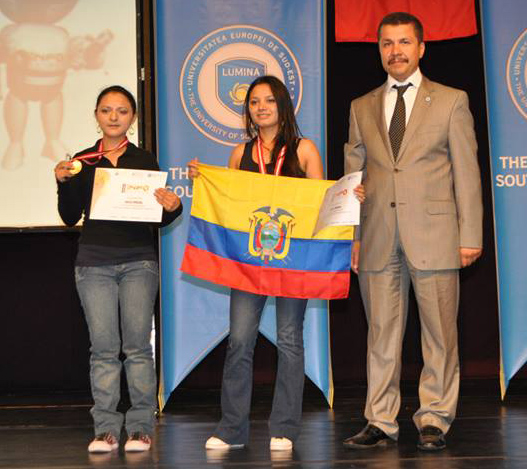
Veronica & Tatiana - World Champions in the Hardware Control Category of Infomatrix 2013

Tatiana & Verónica – World Champions in the Hardware Control Category of Infomatrix 2013

VERÓNICA: 28 years old. Diploma from Ambato High School with specialization in physics and mathematics. Studied Electronic Engineering at the Kennedy Campus of the Salesian Polytechnic University in Quito.

TATIANA: 25 years old. Diploma with a specialization in physics and mathematics from the Manuela Cañizares Experimental Education Unit in Quito, graduating as the Second National Honor Guard. Studied Electronic Engineering and Control at the National Polytechnic School in Quito. Enjoys fabric painting, ceramics and marzipan art as well as learning languages and contemplating nature.

As children, the Benalcázar sisters lived with their grandparents, Arturo Benalcázar and Rosa Gómez in Cotacachi in the province of Imbabura in the northern region of Ecuador.

Their parents, who are engineers, have always been an inspiration to them. Their mother, Ayda Vayas, is a Zootecnic Engineer and their father, Luis Benalcázar, has a Master of Engineering degree and works in the maintenance of ophthalmology equipment. Their grandparents were definitely a source of inspiration with their sewing workshop and the grandfather’s mechanic and carpentry workshops which were his hobby and where Verónica and Tatiana discovered their liking for design and were able to repair or even create their own toys.

They are very creative graphic designers, and they like to investigate and give life to their ideas. They are persevering and look for solutions to different problems by sharing their ideas. When life becomes difficult, they support each other, whether it is in a project or in any other situation.

Their free time is dedicated to painting, sewing, knitting, crafts, designing and building autonomous robots and studying mathematics, physics, chemistry and biology.

Their principal achievements are reflected in the international Infomatrix 2013 competition gold medal award, the Latin American Project Contest gold medal award, first place in 4 international robotic contests, and first place in 5 national robotic contests.

Verónica and Tatiana, tell us briefly about the creation of the first national prototype for ocular surgery which was the experiment that won you the world championship prize in the category of Hardware Control at Infomatrix 2013 in Bucharest, Romania.

It was our own idea (Tatiana and Verónica’s) to create our project with the objective of developing a very complex but practical project in order to show that we can develop technology in accord with the situation of our country and in this way leave a footprint so future generations can find financial support from public and private organizations since it has been very hard for us to get financial help from the competitions we have entered.

In order to enter the international Infomatrix 2013 event, we started with the idea of creating the Vitrectomy Prototype Project at the end of 2011 and worked nearly a year on the project. We presented it to the Scientific Technological Community in our continent and won the gold medal and the 2013 International Accreditation as representatives of Latin America in the Hardware Control Category, giving us the right to enter the 2013 Infomatrix 11th Edition held in Bucharest, Romania from May 16 to 20, 2013.

The Vitrectomy Prototype Project is used in eye surgery to clear vitreous opacities, remove blood, and treat infections and other diseases related to the jelly-like substance called vitreous that fills the ocular cavity.

With the software and hardware we have designed, we (Tatiana and Verónica) control the entry of saline solution through the cannula infusion into the ocular cavity, the intensity of the optical fiber light (endoilluminator probe) that illuminates the eye cavity, and the instrument that makes a very small cut (vitrector) and removes the vitreous.

We carried out research on the prototype for a year. We had to buy books on eye anatomy and vitrectomy surgery. We observed surgeries in operating rooms in order to understand the procedures and needs of ophthalmologists and be able to begin designing and creating the prototype with materials that would be easy to find while meeting ocular surgery requirements, so this was the first vitrectomy prototype produced in our country.

What has becoming world champions in the Hardware Control Category of Infomatrix 2013 meant for you?

It means that our efforts, work and dedication are reflected in this triumph for the entire country. It’s also the fulfillment of our dream to be able to show the world that we’re capable of carrying out technological innovation with the few resources that are available in our country.

Tatiana:                                                                                                                                 We’re very happy and proud to have represented Latin America and Ecuador in this international event where the best projects in the world were presented. 45 countries and 249 projects participated.
We were the only representatives in this category from Latin America in the competition. We competed against the 10 finalists chosen from Azerbaijan, Bosnia and Herzegovina, Georgia, Malaysia, Romania, Turkey and Ukraine. This year, the silver medal was won by Bosnia and Herzegovina, and Ukraine.
We were also very pleased because this year the judges awarded only one gold medal winner and it was for the research, creativity, difficulty, usefulness and originality of our Vitrectomy Prototype Project.

Verónica:
We’re very proud as Ecuadorians and even more as women to be able to represent our country in events of this type. The judges congratulated us for the Project, and they were surprised that with such low cost, easy-to-access materials and with the software and hardware we had designed and built, we had obtained such good results. We were the only two women competing in this category.

We know that you have achieved a number of national and international prizes and awards for all the creative and meticulous work you have carried out with robotic and other types of experiments since you were very young.  What you think has been the principal driving force that has inspired and encouraged you to explore and develop this interesting area of robotics and your inclination for research in general?

The driving force that inspires us to create, design, develop and investigate is the desire to fight to make our dreams come true on a daily basis. That is what enriches all of us in our personal, family and professional lives. It means not limiting our imagination, because we can make our ideas take shape in creations that demonstrate our skills, abilities and knowledge.

We understand that the family environment you grew up in contributed greatly to you being able to give free rein to your dreams and wishes and that now you’re focused on fulfilling them. Share with us briefly some of those unforgettable childhood experiences that have defined your lives in an extraordinary manner and have to some extent determined the successful future you are now beginning to experience.

We remember that we’d design and make clothes, shoes and accessories for our dolls and we’d play with Legos, puzzles, modeling clay and marzipan when we were very small. My sister and I would use the scraps of fabric my grandmother didn’t need or we’d take little pieces of wood and nails and use the tools from my grandfather’s hobby workshop to make toys or adapt those we had to fit our needs or do anything that popped into our minds at the moment.

Our parents gave us a hippopotamus that had a sound box inside that squeaked. We were curious about why it made that noise so we took it apart. Our parents were worried at first because they thought we had damaged the toy on purpose, but the next day we started putting it back together and tried to understand how it worked. When our parents and grandparents saw that it was working again, they were very happy that we were so creative and they encouraged us to continue creating things. This happened when Verónica was 6 and Tatiana was 3 years old.

You are both worthy representatives of young people and most certainly examples of Young People of Excellence. What does a person need to NOT participate in mediocrity? What do you need in order to live as a young person of excellence, to live as spiritually, mentally and physically healthy young people who have the energy needed to fight for their dreams and use them to serve their community?

In order not to participate in mediocrity, it’s important to maintain our identity and put our ideas and beliefs into practice in such a way as not to cause harm to our personal integrity or that of other persons in our midst. This means contributing to the growth of other people. It also means setting daily goals and carrying out our tasks the best we can.

In order to attain excellence, we need to be in harmony spiritually, mentally and physically. For this, we have to recognize our strengths and our weaknesses, believe in ourselves, think positively, give our best even in the worst circumstances, and learn to acknowledge our mistakes.

In our case, our family’s support and the fact they believe in us has helped us on countless occasions, especially when we would reach a point in a project when things weren’t turning out as we had expected. That was when they’d encourage us to continue working on the project.

What challenges have you faced in your academic world and in the beginning of your professional lives because you are women and have entered a field that has probably been mostly identified by and for men?

Our biggest challenge has been overcoming the machismo which has been evident in certain robotic competitions. We’ve had to prove that as women we are entirely capable of achieving great things.

It’s important for women who face great challenges in their lives to believe in themselves. They shouldn’t give up and should continue fighting for their dreams even when they seem unreachable.

You are the present, but you are also the future of our nation and our global community.  God has given you marvelous talents. What are your dreams and vision for the future? How do you plan to serve your community with your talents?

We’re going to continue preparing new projects aimed at helping people. One of our dreams is to study in another country and get a master’s degree in order to share our knowledge and put it into practice so we can contribute to the development of our country.

In conclusion, how would you define “excellence” in the daily lives of Verónica and Tatiana with respect to what is public as well as personal and private?

Excellence in everyday life means trying to be better persons every day. It’s setting goals, learning new things. It means investigating and designing new projects.
In public life, it means solving the problems existing in our society.
In our personal lives, it means being better daughters, sisters and friends.

Interview with the First Ecuadorian Astronaut

Excellence is …“doing something in such a way you can’t ever say you could have done it better.”

COSMONAUT COMMANDER RONNIE NADER

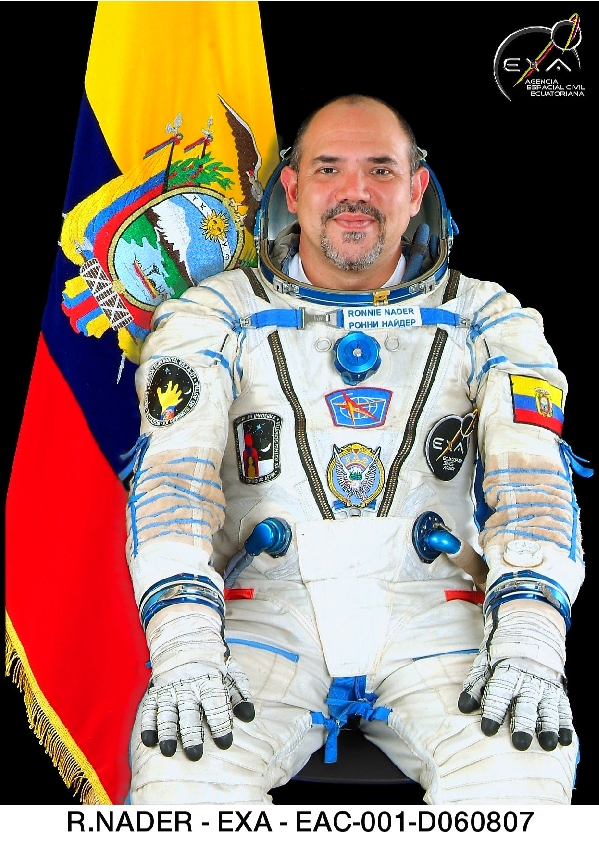
First Ecuadorian astronaut trained at the Gagarin Cosmonaut Training Center in Russia.
Set a record for high gravity tolerance at the Novgorod Air Base.
Founder of the Ecuadorian Civilian Space Agency EXA and creator of the Ecuadorian Civilian Space Program.

FOTO-OFICIAL-RNader

Cosmonaut Ronnie Nader
Courtesy of EXA

Creator of the DEDALO Project and the first microgravity airplane in Latin America.
Set Guinness’ world record with the POSEIDON Project.

Creator of the HERMES ground station, the first permanent internet-to-orbit gateway.

Commander of 7 microgravity missions for the Ecuadorian Air Force.
Creator of the Hyperion ultraviolet radiation monitoring network.
Creator of the first Ecuadorian satellite. Chief Engineer for the Pegaso and Krysaor Projects.
Mission Director for the Ecuadorian satellite program.

44 scientific studies published and defended at national and international levels.
4 Medals for Scientific Merit.

8 national and international recognitions.
Married 18 years to María Mercedes Drouet. They have 3 children: Gerard, 15, Jules, 13, and Elisse 10.
Complete biography at:
http://exa.ec/ronnie-nader.htm

Commander Nader, you are recognized worldwide as the creator of the Pegaso nanosatellite project. What does this mean to you personally? 

Pegaso is one of my dreams come true. I’m going to quote a paragraph from the Letter to the Nation I wrote on behalf of my comrades  and myself in March 2011 before the existence of Pegaso was made known to the country and the world:

“The first memory I have that’s related to space was when I was 2 or 3 years old. It was night and my mother was bathing me. When she finished, she took me out of the bathtub and put me on the bed. While she was putting my pajamas on me, I was watching a TV cartoon of a white horse with wings that flew through the star-filled night sky. I felt I belonged there. I was fascinated by the star-studded sky. This TV show was discontinued and then I landed here. Years later, when I was about 13, I contemplated the stars again and dreamed of building my own space ship. I vowed that if some day I ever did that, the name of the space ship would be Pegaso.

Now, 40 years since Pegaso flew away and left me behind, he has finally returned. Once again he will fly triumphantly through the starlit sky. Once again his silver wings will adorn the black velvet of space, and this time he will sing our national anthem and announce to the world, revolving below his powerful wings that the people who live at the Middle of the World have been able to reach the heavens through the efforts of  their sons. And it’s been their sons alone and their very own hands that have made the dream come true, because we have grown, we have become great, and now we are a Nation of Space.

Now, 40 years later, I offer the incarnation of my most cherished memory to my country. There can be no greater reward for a persevering man than to see his childhood dreams become history.”

How do you think our childhood dreams can finally come true? What’s necessary for that?

In my experience, dreams don’t just happen. You have to search them out and make them happen, and it’s in that journey that we become adults.

You have definitely proven to be self-taught. You even started studying nuclear physics by yourself when you were 13. So you began early and now you’re beginning to harvest the fruit of your labors. But what would you say to people who are no longer children or teenagers but who still have shadows of dreams that pass through their minds and hearts and perhaps sometimes leave them frustrated because they never tried to make them come true?

That it’s never too late. It may be more difficult, but it’s never impossible. That if they really love their dreams, they should risk everything they are for what they can become. That they dare to live as high as their dreams.

Like only a few people in the world, you have had the privilege of surpassing the limits of your imagination and literally crossing the limits of space. Tell us what would happen if on a space mission the crew members didn’t strictly obey the established norms and regulations. I mean if each crew member did “whatever he felt like” and didn’t make much effort or feel committed. Would they face any risks? How bad would it be?

That couldn’t happen. A space mission is very high-risk. The lives of everyone would be in danger if someone didn’t obey an order or simply panicked. That’s why the selection of astronauts is so rigorous. What’s most important is their self-discipline and their even-temperedness.

Using this example of a space mission and how critical the lack of the crew’s commitment in this kind of mission as an analogy, what advice would you give our national and international readers, to average citizens who daily face challenges and struggles in their professional lives or jobs or even in their family life and who have perhaps become infected by the indifference or mediocrity of others?

I can only say what I repeat to my children: a professional does what he has to do when he has to do it and how he has to do it, no matter how he feels or what the circumstances are.

Speaking of challenges, what are the challenges you’re facing now that you’re heading up this Immense Pegaso Project and the challenges you must surely have had to face during the 7 space missions you have commanded? How would you define them generally speaking, and what strategies have you used to overcome them?

We face uncountable challenges, because everything is new for us. That’s the price of being a pioneer. There’s just one strategy -never give up, nothing is impossible!

In your Letter to the Nation of Ecuador (2011), you mentioned that the voluntary team that worked in the creation of Pegaso was “inspired to challenge the unimaginable and conquer the impossible.” What did you and your team need for that to happen and finally reach space, something our ancestors most probably never dreamed of?

I think the most difficult part of the project was managing a group of volunteers, because we couldn’t demand anything of them and could only try to inspire them. The number of things and challenges we had to overcome would be too many to innumerate for these pages, but there were even challenges of a human nature that we had to face and overcome. That was the journey in which we grew as human beings and professionals, because it wasn’t enough for us just to reach our goal. We had to conquer it with honor and sacrifice because it’s not the goal that makes you great, it’s the journey.

What has most motivated and inspired you to fulfill your greatest dream that of reaching space?

I’m going to quote some lines of a song I love. It’s “The Traveller” by Alan Parsons:

The traveler awaits the morning tide
He doesn’t know what’s on the other side
But something deep inside of him
Keeps telling him to go
He hasn’t found a reason to say no.

You are definitely an example of “excellence” for many. What does “being excellent” and “acting with excellence” mean for you in practical terms?

Doing what I have to do how I have to do it and when I have to do it. Doing it well, doing it fast and doing it so I can’t say I could have done it better.

And now as we’re about finished, I invite you, Commander Nader, and our readers to imagine just for a moment that we’re all part of a “Towards Excellence” Space Mission and each one of us has been assigned a specific function. You, of course, are the Commander of the mission. What instructions and advice do you have so this mission “towards a life of excellence” will be successful?

That you live as high as your dreams, that you don’t reach old age looking back and wishing you’d give anything to relive this moment and that you risk everything in at least attempting to carry out that great project, that great dream that’s always been hanging out there like a star in the window of your soul.

To conclude, how does Ronnie Nader define or identify himself?

I’m going to quote a couple of paragraphs of and article I wrote in 2007 for the Air Force Schools:

“Today I’m a 41-year-old astronaut, the first in the history of my country and I’ve been the Commander of 7 space missions. My space suit is black like space and silver like the stars. I was able to establish my country’s first Space Agency, the only civilian space program in the world, and I’ve given it the technology needed to defy gravity. Thanks to it, we established the first scientific world record in the Guinness Book of Records. Today my country is a recognized leader of space. Today they call me a “hero” for putting my country in first place, second to none.
However, down deep in my heart I’m really just 7 years old, still playing inside a cardboard box, still in love with the moon.”

Surrounded by Excellence!

I was born in a small country in South America characterized by its diversity of scenery, flora and fauna, and most certainly, its people. It’s true that it’s a small country, but it has a vast wealth of biodiversity and people of different races who all have enormous and generous hearts. I was born right in the Middle of the World –in Quito, the capital of Ecuador.

And this small country just 109,484 square miles in size is divided in 4 regions. Let’s take a quick look! The coast is where you can enjoy beautiful beaches along the entire Pacific Ocean shore. And you can explore a number of ecosystems here also –tropical and dry forests, mangroves and rocky cliffs.

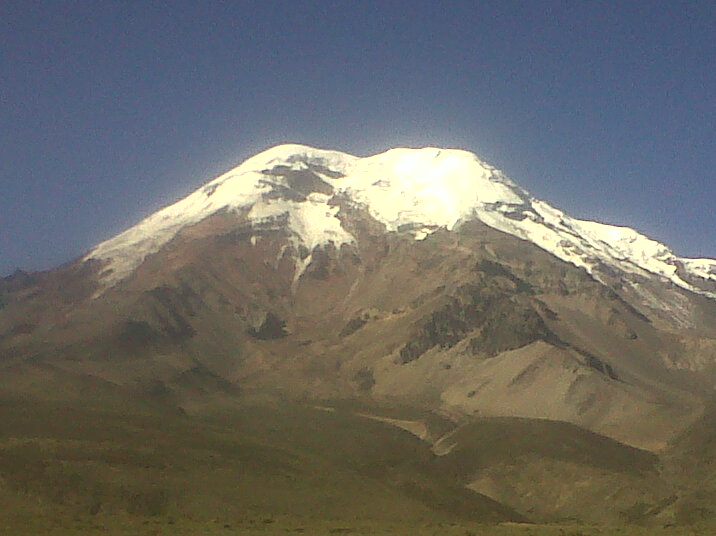
El Chimborazo

Chimborazo snowcap

The sierra is characterized by mountains and snow peaks that form the renowned Andes Mountain Range with more than 20 volcanoes, about 5 of which are still active. It is here where the imposing Chimborazo rises to 20,564 ft.

Continuing on with this expedition, we have to cross the Amazon forest, a region rich in thousands of birds, mammals, insects and other creatures that harmoniously co-inhabit in this amazonic paradise. And finally, there are the famous Galapagos Islands, an extraordinary venue where warm and cold currents attract and unite unique species. UNESCO has declared this exotic archipelago as Natural Heritage for Humanity.

So I’ve lived a great part of my life in my country, Ecuador, where I’ve shared a few fleeting impressions. However, I’ve also had the unique opportunity to travel and see other countries, other cultures, other races, and most certainly, other panoramas. I’ve visited about 25 countries in 4 of the 5 continents, and what’s been most extraordinary in these incomparable travel experiences has been discovering places just as beautiful and wonderful as those of my own country. I’ve met people from very different cultures, but they’ve proven to be very much like my people. They’re people who to some extent face the same kinds of problems, and they share the same emotions of happiness, sadness, anguish, dream and hope. Some of their childhood dreams have come true and unfortunately, others have not.

All of us, absolutely all of us on this planet Earth are undoubtedly surrounded by excellence. It makes no difference whether we’re wealthy or poor. Some of us will delight in the majesty of the mountains and someday some of the bravest of us may even climb them. Some of us will delight in swimming or even sailing in the midst of playful waves; while still others will almost certainly experience the adventures of the legendary Tarzan as they live and grow up in thick, exotic jungles.

And all of us, absolutely all of us will someday look up at the sky and see its beauty. The sunlight will shine so brightly on our faces that our eyes won’t be able to resist it. And at night, the moon and stars will convince us there’s Someone who’s guiding us even in the dark.

Mountains, rivers, valleys, hills, oceans, mangroves and exotic jungles… Sun, moon, stars, constellations and infinite space… All of it created to perfection!

Who could have made this so perfectly, so precisely, so meticulously?

This is the world that surrounds me –the world that surrounds all of us. It’s a world originally created in perfection and beauty, assembled with the utmost skill and precision.

And it’s not limited just to this world, our planet or even our galaxy. We’re so infinitely small when we compare ourselves with the great universe and the hundreds of millions of existing galaxies. Who are we? Who made this planet that’s our home, and who made this planet’s home, the universe?

Look at the evening sky! Who created the stars? Who gave them each a name? Who leads them like an army? The LORD is so powerful that none of the stars are ever missing… Don’t you know? Haven’t you heard? The LORD is the eternal God, Creator of the earth. He never gets weary or tired; His wisdom cannot be measured.” (Isaiah 40: 26, 28 – CEV)

I personally feel there is no other answer but this. Yes, this is the God, the Creator of the Universe, who has given us the privilege of living and administering a very small part of His extraordinary and vast creation –the Earth.

And it is this God and His creation who inspires me every day to live and further excellence in every area of my life and in everything I’m involved in, because I myself am His creation, just as His Word assures me:

“For we are His workmanship, created in Christ Jesus for good works, which God prepared beforehand so that we would walk in them.” (Ephesians 2:10 – NASB)

Consequently, this is my commitment –to be an instrument of God, to be His ambassador and further His Kingdom and to live a life that pursues excellence in every place, at every moment and in every thing, and most definitely, promote this kind of life in every country where it’s possible for me to do so.

I know I was created by the God of excellence and now I’m called to live and lead a life that strives towards excellence.

So have you stopped to think that in spite of how difficult your circumstances may be, you are still surrounded by excellence?

Do you know that you were created by God, the Creator of the Universe and that you were created for “good works”?

Wouldn’t you like to join this journey towards excellence?

***

Our Time, a Time of Extraordinary Progress?

sign

Source: http://bit.ly/16KJGbx  used under CC license.

We live in a time of enormous technological progress, with inventions that surpass our imagination and most certainly, with instant global communication.

Imagination, creativity, ingenuity and innovation in this century have facilitated human existence to the greatest degree possible and have astoundingly improved living conditions.

Extraordinary advances have been made in medicine, satellites have been launched into space in an effort to better understand the universe, and even before these events, traveling time between countries as well as continents became dramatically reduced. With just a simple “click,” a video conference can unite families, friends and even big cyber business negotiations in a virtual embrace.

This century is most certainly worthy of the admiration and recognition of the people who have made it possible for humanity to advance, excel and reach the height of its splendor of development.

Excellence viewed from this perspective is undoubtedly the distinctive mark of this century.

However, in contradiction with and in spite of these extraordinary advances witnessed daily, there is a part of our daily lives that has not been affected by the example of the excellence evidenced in the substantial changes in this century.

Therefore, we sadly observe and even experience the intolerable bad medical practices that have caused so many unfortunate events and have even caused the death of loved ones.

Many of us have had to conduct business in public offices as well as in private enterprises where leading edge technology is honorably encouraged in order to serve customers with high quality standards. Nevertheless, our experiences have been chaotic when systems have not functioned according to the way they have been publicized or even worse, when the personnel in these places have not provided us with proper or effective attention.

On the other hand, the more we study and try to understand the laws of the universe, the less we understand ourselves as human beings and we increasingly experience broken relationships.

Additionally, the easier it is to widen our public life through social networks, the less effort we make to strengthen our personal and family relationships, and we end up experiencing failed relationships.

This is precisely the paradox of this century. It is the age of technological development, telecommunications and social networks versus the age of weakened human relationships and family disintegration.

Businesses loudly proclaim high quality standards from the perspective of their advanced digital technology, but they forget that more important than their perfectly developed systems with telephone exchanges, call centers and digital banks, etc. are human resources that should receive special attention, care, encouragement and development because it is human resource and not technology per se that is the real motor that drives businesses towards true excellence.

In the same way, it is in the nucleus of the family where every member needs to experience love, comprehension, support and a sincere embrace, even in the midst of failure, so a family can experience healing and restoration and so every human being can set off on his or her journey as a person seeking excellence.

There are so many different areas in which the practice of excellence is implicit, and there are many more aspects that need to be discussed regarding this topic.

Every month, I will share stories, my personal experiences and those of close friends plus some advice and recommendations along with an invitation to share moments of reflection and learning for a life that pursues excellence.

Welcome and thanks for joining me in this journey towards excellence!

***

“Excellence is doing ordinary things, extraordinarily well.”

John W. Gardner