
Key Scripture: Deuteronomy 6:6–7 (NKJV)
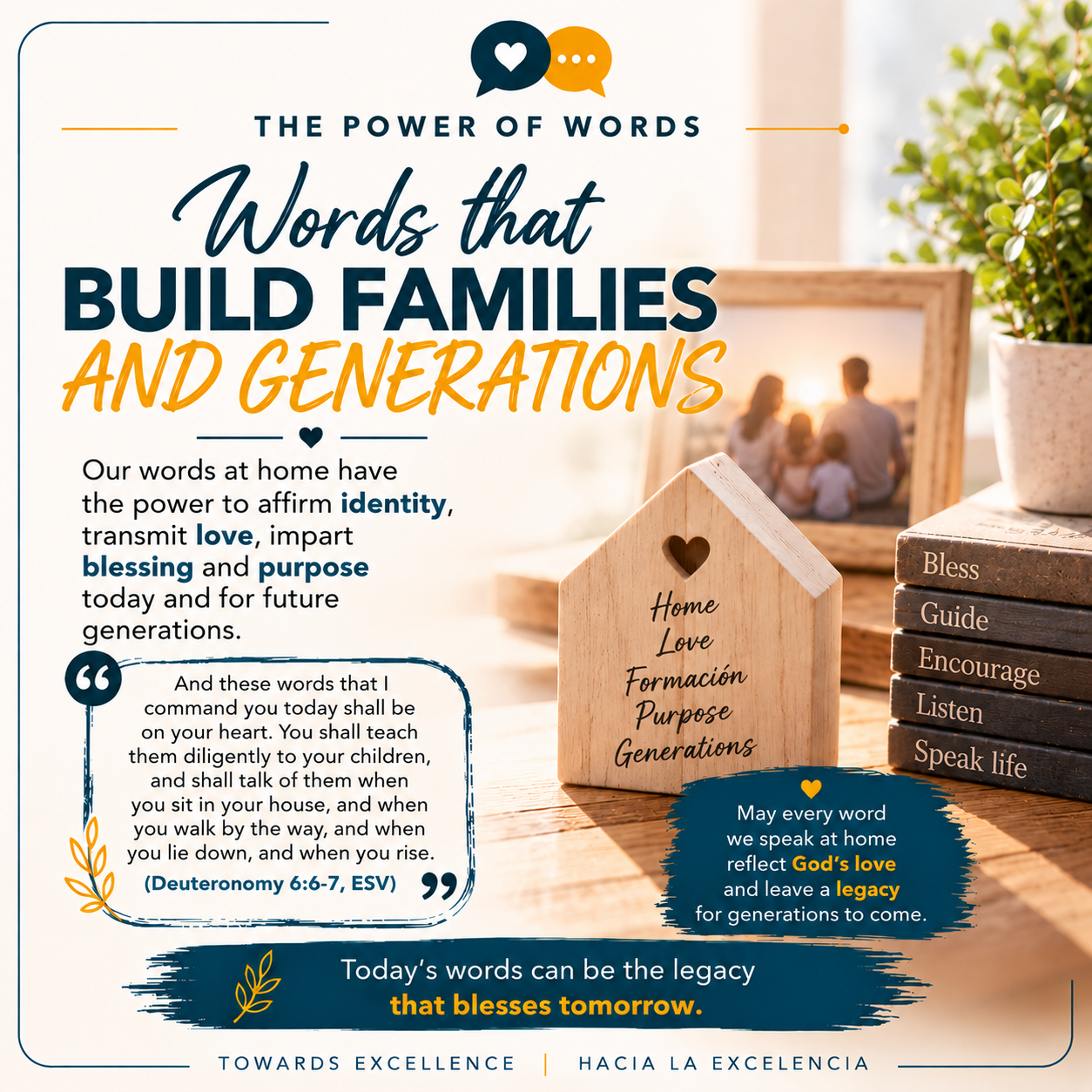
“You shall teach them diligently to your children, and shall talk of them when you sit in your house, when you walk by the way, when you lie down, and when you rise up.”
There are words we hear as children that we can still remember decades later. Some made us feel loved, capable, and secure. Others left wounds that may have taken years to heal. Home is our first school of communication, and the voices of those who love us have an extraordinary influence on how we begin to understand who we are.
That is why the Bible places such great importance on the words spoken within the family. God instructed His people to speak of His truth with their children throughout everyday life: while sitting at home, walking along the way, lying down, and getting up. The purpose was not merely to pass on religious information, but to raise a generation that would know God, remember His works, and learn to live according to His truth.
Words That Affirm Identity
Children need correction, boundaries, and discipline. But they also need to hear words that communicate love, acceptance, and purpose.
“I love you.” “I thank God for your life.” “You can learn from this mistake.” “God has given you gifts and abilities.” “I’m proud of the effort you’ve made.” “I’m here for you.”
These expressions may seem simple, but when spoken consistently over the years, they help create an environment in which children know that their worth does not disappear when they make mistakes.
This does not mean feeding an inflated ego or telling our children that everything they do is right. Biblical blessing is not flattery. Love also involves correction. But there is an enormous difference between correcting a behavior and attacking a child’s identity:
“What you did was wrong” is not the same as “You are a failure.”
One statement addresses an action; the other can become a label a child carries for years.
Developmental science also underscores the importance of these interactions. Harvard University’s Center on the Developing Child explains that responsive, attentive relationships—characterized by back-and-forth exchanges between a child and a caring adult—help build important brain connections associated with language, social skills, and emotional well-being. Even before children can speak, naming what they see, do, or feel helps establish connections related to language development.
Blessing a Child Before Birth
Our responsibility to love and affirm a child’s life can begin even before birth.
A mother might place her hands on her belly and say, “My child, you are loved. I thank God for your life. I pray that you will come to know the Lord and fulfill the purposes He has for you.”
This is not about attributing magical power to our words or believing that we can determine a child’s future through our declarations. Power and sovereignty belong to God. Rather, it is about recognizing from the very beginning that this life has value because it was created and is known by Him.
“Before I formed you in the womb I knew you.” — Jeremiah 1:5 (NASB)
“For You formed my inward parts; You wove me in my mother’s womb.” — Psalm 139:13 (NASB)
What a powerful foundation for a family! Before a child can demonstrate any ability, achieve anything, or even speak a single word, that child’s life is already known by God. Their worth does not begin with what they do, but with the One who gave them life.
What Legacy Will Our Words Leave?
Children grow up. One day, they leave home. But many of the words spoken around the dinner table, in the car, at bedtime, or during a crisis stay with them.
That is why it is worth asking ourselves: What voice are we leaving in the hearts of the next generation?
Perhaps some of us grew up without hearing words of affirmation. Maybe we still carry memories of criticism, comparisons, or remarks that made us feel inadequate. But our history does not have to repeat itself. In Christ, we can begin a different legacy.
We can be the generation that learns to say, “I love you,” “I’m sorry,” “I believe in you,” “I’m here for you,” and “Let’s pray together.” A generation that corrects without tearing others down, blesses without flattering, and speaks God’s truth about the identity and purpose of those He has entrusted to our care.
The words we speak today can become part of the spiritual and emotional legacy our children carry into tomorrow.
Personal Reflection
Ask yourself today: What are the people closest to me learning about themselves, about others, and about God through my words?
Let us ask the Lord for wisdom so that our homes may be places where truth is spoken with grace, where correction is given without humiliation, and where each generation learns to use its words to bless the next.
And this principle does not end at our doorstep. Words can also build up—or undermine—teams, businesses, and organizations. In our next article, “Words That Transform the Workplace and Leadership,” we will explore how to correct without humiliating, provide constructive feedback, and foster organizational cultures grounded in respect and trust.
Until next time!
Sources:
1. Center on the Developing Child, Harvard University. “Serve and Return: Back-and-Forth Exchanges.”
https://developingchild.harvard.edu/key-concept/serve-and-return/
2. Center on the Developing Child, Harvard University. “5 Steps for Brain-Building Serve and Return.”
https://developingchild.harvard.edu/resources/briefs/5-steps-for-brain-building-serve-and-return/
 Cecilia (Cecy) Yépez was born in Ecuador, South America.

Recent Comments