
Monthly Archives: November 2026

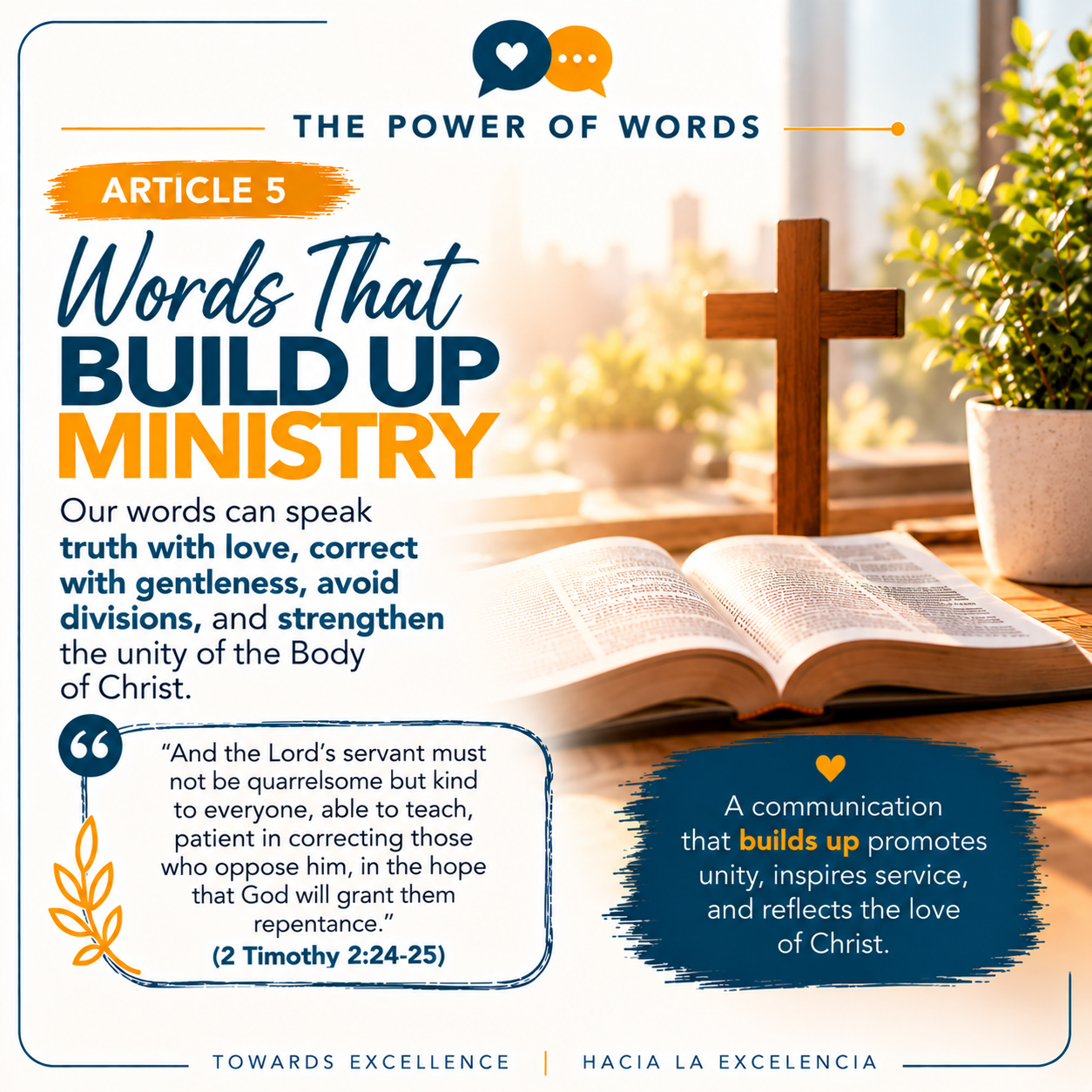
THE POWER OF WORDS – Article 5: Words that Build Up Ministry

Key Scripture: 2 Timothy 2:24–25

“The Lord’s bond-servant must not be quarrelsome, but be kind to all, skillful in teaching, patient when wronged, with gentleness correcting those who are in opposition.”

Truth Has a Tone

In Christian ministry, being right is not enough. How we communicate truth also matters. Paul describes the servant of the Lord as someone who is not quarrelsome, but teaches and corrects with gentleness. Sound doctrine never needs arrogance, contempt, or humiliation in order to defend itself.

Correcting in Order to Restore

There is a profound difference between correction and destructive criticism. Biblical correction identifies what needs to change and seeks restoration; destructive criticism discredits the person, generalizes failures, or turns them into conversation with third parties. Before speaking, we should ask: Do I want to help my brother or sister grow, or simply prove that they are wrong?
Unity Is Not Uniformity

The Church is made up of people with different histories, cultures, temperaments, and perspectives. Biblical unity does not require us to think exactly alike on every secondary issue; it calls us to remain united in Christ and to treat one another as members of the same Body. Barna research found that pastors and Christians do not always understand “unity” in the same way; only 35% of surveyed Christians said they most often experience unity in their church. This reminds us that unity must be cultivated intentionally.

Beware of Conversations That Divide

An unnecessary repeated comment, a suspicion presented as fact, or criticism shared with someone who cannot resolve the issue can create deep wounds. When a real conflict exists, the healthier path is not to build factions, but to pursue truth, prayer, direct conversation, and reconciliation according to biblical principles.

Words Worthy of the Body of Christ

Every conversation within the Church should recognize that the person we are speaking about—and speaking with—belongs to the Lord. We may disagree, establish boundaries, and correct when necessary, but our words should still reflect Christ’s character. The question is not only, “Is what I am about to say true?” but also, “Is it necessary, edifying, and am I saying it in love?”

Even when we seek to speak in love, conflict will come. In our next article, “Words That Bring Peace in the Midst of Conflict,” we will explore how to listen before responding, handle disagreements wisely, and keep our words from deepening wounds.

Sources:

• Barna Group, “Pastors Say They Often Preach on Church Unity—Christians Disagree.” https://www.barna.com/research/pastors-christians-unity/

• American Psychological Association, “Civil Discourse Project.” https://www.apa.org/education-career/k12/civil-discourse

THE POWER OF WORDS – Article 4: Words that Transform the Workplace and Leadership

Key Scripture: Colossians 4:6

“Let your speech always be with grace, as though seasoned with salt, so that you will know how you should respond to each person.”

Words Go to Work, Too

We spend a significant part of our lives in workplaces—businesses, entrepreneurial ventures, organizations, ministries, and projects. There, words are never secondary. A conversation can clarify a vision, encourage someone who is discouraged, correct a course, or, conversely, create fear and distrust. Colossians 4:6 reminds us that even firmness can be expressed with grace.

Leadership Without Humiliation

Authority does not need to demean in order to be effective. A leader can address an error clearly without attacking the dignity of the person who made it. “This result needs improvement” is not the same as “You never do anything right.” The first identifies a situation that can be corrected; the second turns a failure into a label. Biblical correction seeks truth, accountability, and growth—not shame.

Feedback That Develops People

Organizational research points to a practical principle: feedback is more effective when it is frequent, specific, and focused on development. Gallup reports that 80% of employees who say they received meaningful feedback in the previous week are fully engaged. The Center for Creative Leadership recommends focusing on behavior—not the person—and delivering a single, specific message with sensitivity. That closely reflects communication that tells the truth without tearing someone down.

It is Built One Conversation at a Time

An organization’s culture does not live only in its written values. It is revealed in how we speak under pressure, respond to mistakes, recognize good work, and listen to differing opinions. Respect and trust grow when people know they can speak, ask questions, and receive correction without humiliation.

A Personal Question

What happens to people after a conversation with me? Do they leave with greater clarity and courage to grow, or with fear and a sense of being diminished? Leading with gracious words does not mean avoiding difficult conversations; it means having them with truth, respect, and purpose. A Christian leader does not use a position to prove superiority, but to serve, develop, and lead others with integrity.

Our words, however, do not affect only businesses and teams. They can also strengthen—or weaken—the unity of the Church. In our next article, “Words That Build Up Ministry,” we will explore how to speak the truth in love, correct with gentleness, and protect the unity of the Body of Christ.

Sources:

• Gallup, “How Effective Feedback Fuels Performance.” https://www.gallup.com/workplace/357764/fast-feedback-fuels-performance.aspx

• Center for Creative Leadership, “Relationship Skills at Work.” https://www.ccl.org/articles/leading-effectively-articles/building-relationship-skills/